
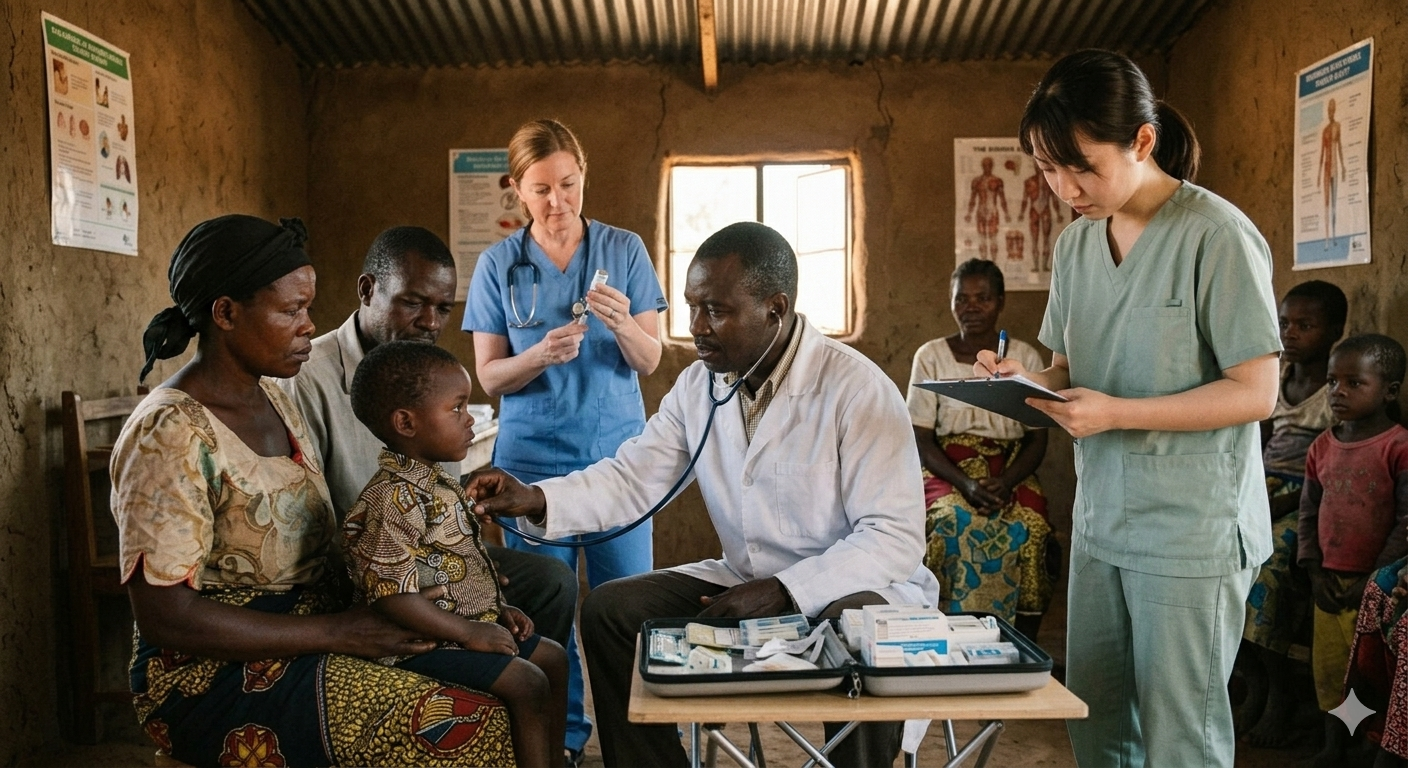
At a recent global conference of Christian medical doctors, a talk entitled “A Revolution in Healthcare Missions” sent a buzz through the auditorium. The speaker called for an end to the old, Western-centric model, addressing the dangers of a colonial mindset. It is an important critique, but afterward I heard many asking, “Is there still a need for medical missions?” I began wondering if we were missing the real problem.
If we assume that paternalism is strictly a Western problem, we miss the diagnosis entirely.
When Jesus said, “Blessed are the poor in spirit,” He wasn’t addressing a single passport country or culture; He was diagnosing the universal human condition. The true friction in modern medical missions doesn’t stem from Western culture itself, but from a symptom of an ancient disease: sinful pride and the desire for cultural dominance. Whether we hail from the West, East, or Global South, our default setting as broken human beings is to put our own perspective at the center of all things. The revolution we desperately need in healthcare missions is far more radical than shifting leadership from one hemisphere to another—it is a universal surrender to cultural humility under the authority of the Word of God.
Is Medical Missions Just a Form of Western Colonialism?
Our modern concept of medical missions emerged after William Carey, the father of modern Protestant missions, arrived in Calcutta from England in 1793. Decades later, in the 1830s, Dr. Peter Parker brought eye care and gospel witness to China. Enthusiasm for medical missions surged throughout the 1800s, driven by a passion for world evangelization and a desire to share groundbreaking scientific breakthroughs like asepsis, anesthesia, and X-rays. This impact only intensified throughout the 20th century, particularly following World War II. It grew up during the era of colonialism.
By 1970, as colonial powers gave way to newly independent nations, mission hospitals welcomed a broader paradigm: primary healthcare. This pivot placed a heavy emphasis on community transformation and collaborative national partnerships. Slowly, the global church outside the West began to find its voice.
To put this shift in perspective, look at the numbers. In 1910, 90% of the participants at the Edinburgh global missions conference were Westerners. Today, that reality is practically reversed. The success of the Western mission enterprise has, in part, given rise to a global church, which is beautifully worldwide and diverse.
Yet, during that recent conference, the speaker leveled sobering critiques against the “old” paradigm:
- An individualistic approach to ministry
- Strategies driven too heavily by commercial business models
- Unhealthy competition between denominations
- A lack of cross-organizational collaboration
- Ministry driven by a “savior” complex rather than true solidarity
Sadly, there is truth to these allegations. Read some examples from my own mission, SIM. Healthcare missions have certainly been influenced by the cultures of the nations from which they emerged, including both blessings and blind spots. We must honestly lament the areas where Western foreigners have acted out of paternalism. While the core intent of these pioneers was to promote the Gospel of Christ, an unintended consequence was often the promotion of Western culture as well.
However, the vital shift we must make is away from cultural paternalism, not Western culture itself. We as Westerners must continue to struggle to see our own blind spots, but Christ’s commission to go into all the world remains unchanged. The cultural trappings of Westernism must give way to God’s design for building His global church. We are called to embody the cross-cultural, multilingual family of God pictured in Revelation 7:9. Love, collaboration, and partnership are the true currencies of the worldwide body of Christ.
The fundamental shift needed in healthcare missions is not a geographic flight away from the West, but a spiritual flight away from sinful ethnocentrism. The West must participate, but as a humble, servant partner alongside others. We desperately need each other to expose our respective cultural blind spots. As Jesus said, “By this shall all men know that you are my disciples, that you love one another.” This requires moving away from our tendency to focus on healthcare alone and move toward healthcare ministry saturated with the gospel. Success in modern missions is measured by making disciples and building local leadership for ongoing gospel ministry.
Why the Preaching of the Cross is Foundational, Not Imperialistic
The strategic shift today moves Westerners away from the center of ministry and toward deep collaboration, resource-sharing, and equal partnership with existing local ministries. How can this succeed in a fragmented world where nations and cultures are deeply polarized?
True unity is made possible by Jesus Christ Himself, not by our human capacity to collaborate. Sin naturally dismantles collaboration. We are broken creatures, but the grace of God restores us to Himself and unites us under a singular, God-ordained purpose.
An imperialistic gospel is a false gospel—it is a message dressed up in the deceptive garments of earthly power, wealth, and reputation. Instead, we must cling to the cross of Jesus as simple sinners saved by grace who want others to know Him. The cross is our only hope for effective medical ministry.
This means the most crucial shift in healthcare missions is moving from a self-driven agenda to a self-giving one. This standard applies to every culture, not just Western ones. Apart from the redeeming work of Christ, every human culture is misdirected by sin. Medicine originating from any culture can easily choose power, prestige, and self-importance. Alternatively, it can choose weakness, humility, and the glory of God. As research into cross-cultural ministry shows, those who serve in healthcare must view themselves as servants of all, especially the weak and the marginalized.
It is not Western culture that is the enemy; it is our universal, sinful tendency to place ourselves at the center of the universe. Western, Eastern, and Southern practitioners alike all require the renewing life of Jesus to overcome this. The Gospel must remain our wellspring. While professional collaboration is vital, the ultimate root of our work is the cross.
Medical care can never replace the Gospel. We must never reduce medical missions to mere humanitarianism or social work under the guise of cultural sensitivity. We must be driven by the exact same conviction that has compelled Christ’s servants for centuries: announcing the good news of the forgiveness of sins and calling people to repentance and faith. Thousands of unreached communities can still only be reached by cross-cultural pioneers. Let us work toward collaborative, cross-cultural efforts that utilize healthcare as a beautiful, strategic tool within the larger picture of what God is doing globally.
Spiritual Synergy: Practical Steps for True Collaboration
How do international healthcare workers and local believers collaborate practically to update our methods while staying true to the message of the cross? Consider these steps:
- Embrace Vulnerability: Allow God to refine you through the vulnerability of cross-cultural service; choose to be a cross-cultural mission worker. Every one of us carries cultural baggage, family traditions, and inherent brokenness. Deep friendship, mutual learning, and shared growth in Christ must form the center of the team, with medical practice flowing naturally out of that core.
- Cultivate High-Context Leadership: Develop leaders who can navigate complex interpersonal conflict. This means lean into crucial, emotionally charged conversations with humility. Our ultimate success is found not just in clinical excellence, but in the depth of our loving relationships.
- Expand Your Vision: Seek a vision vast enough to encompass God’s ultimate purpose—restoring entire individuals and communities to Himself, not just temporarily fixing broken bodies. This requires listening carefully to international peers, local pastors, and community believers. Dive deeply into the Scriptures together to understand how your local medical efforts fit into His global framework.
- Prioritize Disciple-Making: Do not let the work terminate with physical healing. Do the work of an evangelist. Keep the local church at the center of your strategy. Remember that the primary command of the Great Commission is to make disciples.
- Partner at the Governance Level: Align yourself with mission agencies that practice multi-directional partnership at the highest leadership levels. My own organization, SIM, has worked intentionally to shift away from a “one-way” mentality, transitioning into a movement that flows from “everywhere to everywhere.”
Turning Insight into Action
The current challenges and opportunities facing global healthcare missions are staggering. Let us pray for healthcare laborers from every nation to go to the nations. Our methods must change, and our means of collaboration must adapt. But while methods change, the message must never change, because our Master does not change.
The deepest revolution we need does not originate from changes in Western demographics, but from repentance for the sinful tendencies within our own hearts and cultures. The most effective, innovative ministry models will likely arise where the need is greatest—among suffering, broken communities that are desperate for Christ.
Those who develop these new frontiers will not be academics or armchair theologians. Many will be ordinary healthcare workers—both local and foreign—whose roots are deeply grounded in Christ. These methods will be born out of sweat, tears, and prayer, fostered by a mutual submission to Christ across different tongues and cultures. They will emerge as we identify the cultural blinders that keep us from shining brightly for the Lord.
It will require immense cultural humility and unwavering courage to cling to the gospel of Jesus. Will you be one of them?


Leave a Reply